
ISO 9001 to AS9100 Gap Analysis Guide
Download our AS9100:2016 Gap Analysis Guide to discover the major additional requirements found in AS9100 as compared to ISO 9001.
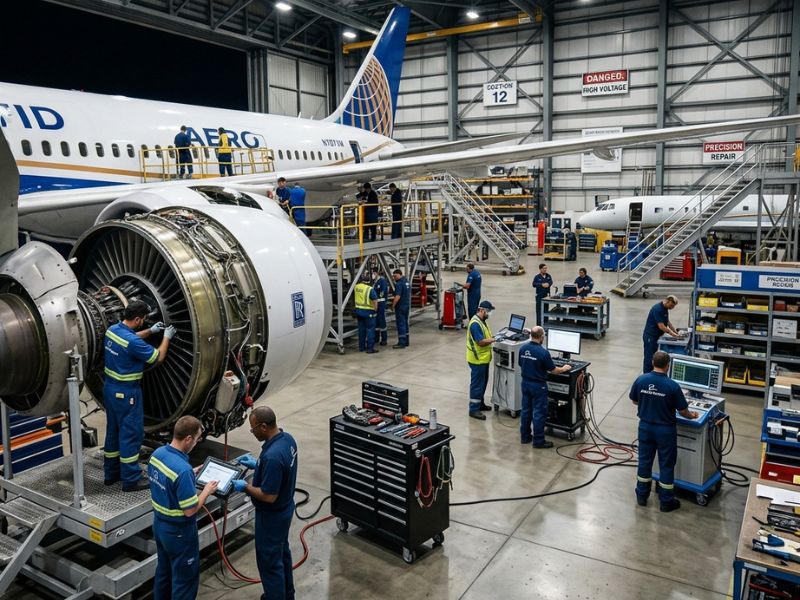
Quick Answer: AS9110 is a quality management standard specifically designed for aviation maintenance, repair, and overhaul (MRO) organizations. It builds on ISO 9001 with aerospace-specific requirements, helping MRO providers demonstrate regulatory compliance, reduce risk, and win contracts with major aviation customers.
Aviation maintenance is one of the most tightly regulated industries on the planet—and for good reason. A single oversight can have catastrophic consequences. AS9110 certification exists to ensure that maintenance, repair, and overhaul organizations meet the rigorous quality standards that the aviation industry demands.
This post breaks down what AS9110 certification means, why it matters for MRO organizations, and the steps required to achieve it.
AS9110 is an internationally recognized quality management standard developed by the Society of Automotive Engineers (SAE) and the International Aerospace Quality Group (IAQG). It is specifically designed for organizations that perform maintenance, repair, and overhaul activities on civil and military aircraft.
AS9110 is built on the foundation of ISO 9001—the world's most widely adopted quality management standard—but extends it with additional requirements tailored to the unique demands of aviation. These include first article inspection, configuration management, airworthiness documentation, and traceability of aviation parts and materials.
The current version, AS9110 Revision C, aligns with the ISO 9001:2015 framework and incorporates risk-based thinking, a stronger emphasis on leadership accountability, and enhanced requirements for managing the supply chain.
In short, AS9110 certification is formal evidence that an MRO organization has implemented a quality management system (QMS) capable of consistently delivering safe, airworthy, and regulation-compliant maintenance services.
The aviation industry operates under strict oversight from bodies such as the Federal Aviation Administration (FAA) and the European Union Aviation Safety Agency (EASA). While AS9110 certification is not a direct regulatory requirement from these agencies, it carries significant weight in practice.
Here is why:
Customer requirements. Major airlines, defense contractors, and aircraft manufacturers increasingly mandate AS9110 certification as a prerequisite for doing business. Organizations without it often find themselves excluded from competitive bids before the process even begins.
Risk reduction. AS9110 requires MRO providers to identify, assess, and mitigate operational risks systematically. This structured approach to risk management reduces the likelihood of errors that could compromise aircraft safety or trigger regulatory action.
Regulatory alignment. The AS9110 framework maps closely to FAA Part 145 and EASA Part-145 repair station requirements. Organizations that implement AS9110 often find the path to regulatory approval significantly smoother as a result.
Operational efficiency. Beyond compliance, AS9110 drives process discipline. Organizations that achieve certification typically report measurable improvements in on-time delivery, rework rates, and documentation accuracy.
For MRO organizations competing in a global marketplace, AS9110 certification is a credibility signal that differentiates them from non-certified competitors.
Achieving AS9110 certification involves a structured process. The timeline varies depending on the size and complexity of the organization, but most MRO providers should plan for a preparation period of six to eighteen months before certification audit.
Start by comparing your current quality management system against the AS9110 Revision C requirements. A gap analysis identifies where your existing processes already meet the standard and where significant work remains. This step is critical for accurate project planning and resource allocation.
Address the gaps identified in your analysis by developing the required procedures, work instructions, and documentation. Key areas include configuration management, airworthiness control, first article inspection, and counterfeit parts prevention. Leadership commitment at this stage is essential—AS9110 places explicit requirements on top management to demonstrate active involvement in quality outcomes.
All personnel whose work affects product or service quality must understand their responsibilities under the AS9110 framework. Training should cover both the requirements of the standard and the specific procedures your organization has implemented.
Before inviting an external certification body, conduct a full cycle of internal audits to verify that your QMS is operating as intended. Internal audits surface non-conformances while there is still time to correct them without impact on your certification timeline.
AS9110 certification must be issued by a certification body accredited through the IAQG's Online Aerospace Supplier Information System (OASIS). Working with an accredited body ensures your certification is recognized by customers and regulators globally.
The certification audit takes place in two stages. The Stage 1 audit is a documentation review to confirm your QMS is ready for full assessment. The Stage 2 audit is an on-site evaluation of whether your QMS is effectively implemented across the organization. Successful completion of both stages results in AS9110 certification, typically valid for three years, with annual surveillance audits.
No. AS9100 applies to organizations that design and manufacture aerospace products. AS9110 is specifically designed for MRO organizations. A third standard, AS9120, covers aerospace distributors. All three are built on ISO 9001 but address different segments of the aerospace supply chain.
AS9110 certification is not legally mandated by aviation regulators such as the FAA or EASA. However, many original equipment manufacturers (OEMs) and airline operators require it contractually, making it a practical necessity for MRO organizations seeking to grow their customer base.
An AS9110 certificate is valid for three years from the date of issue. Certification bodies conduct annual surveillance audits in years one and two to verify continued compliance. A full recertification audit is required at the three-year mark.
Costs vary depending on the size of the organization, the scope of the certification, and the certification body selected. Expenses typically include internal preparation costs (staff time, training, consultancy), audit fees, and ongoing surveillance audit fees. Organizations should budget accordingly and treat AS9110 certification as a long-term strategic investment.
Yes. Organizations that both manufacture and maintain aerospace products can pursue certification to both AS9100 and AS9110. Certification bodies often conduct integrated audits for organizations seeking multiple aerospace certifications simultaneously.
AS9110 certification is the recognized benchmark for quality in aviation MRO. It demonstrates that an organization has the processes, controls, and accountability structures needed to deliver safe, compliant maintenance services—consistently and at scale. For MRO providers looking to strengthen customer relationships, reduce operational risk, and compete for high-value contracts, AS9110 is not just a credential. It is a strategic foundation.
The path to certification requires commitment, but the process itself is well-defined. Starting with a thorough gap analysis, building a compliant QMS, and partnering with an IAQG-accredited certification body gives any MRO organization a clear and achievable route to AS9110 certification.
Achieve operational excellence and secure your competitive advantage with AS9110 certification—contact us today to learn more about our services or request a quote to get started.