Distribution testing standards must always be evaluated for how well they reflect real-world packaging performance. The ultimate goal for packaging engineers and supply chain managers is to optimize packaging and unitized load configurations to reduce overall packaging costs while maintaining little to no damage in transit. Testing also needs to be optimized so that samples are not over-tested relative to real-world conditions.
This was the impetus for submitting formal change requests to ISTA for standard revisions to 3E. Multiple instances were reported where packaged products were being successfully shipped but were failing the compression testing defined in ISTA 3E. Smithers was actively involved in chairing a committee of industry experts to develop an improved predictive tool. The result of this technical review was modifying the ISTA 3E standard. This short overview with Technical Director, Mike Kuebler, will go through:
- A general overview of the standard
- What has changed
- What you need to know for future testing programs
What Is ISTA 3E?
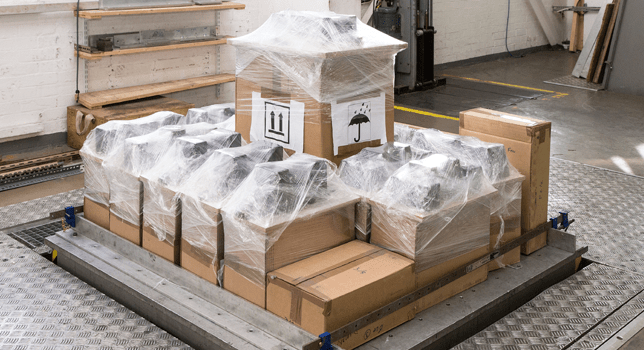
ISTA Procedure 3E governs distribution testing for unitized, palletized loads of similar products moving through full truck load (FTL) shipments. This involves warehousing, vehicle transport, and multi-point handling. It is the standard most commonly used with many products destined for retail supply chains. The standard includes atmospheric preconditioning, various shock methods, vibration, and compression testing.
Changes from the 2026 Revision
Several areas were evaluated for adjustment to assist with better real-world predictive performance:
Compression Formula Modified and Aligned
The 2026 revision reverts to the prior 3E formula, which is now aligned with ISTA 3H. It adds language requiring testers to use the largest potential stack for calculations. For example, if your unit load is generally stacked 2-high in a truck but stacks 3-high in a warehouse, you would test using a 3-stack configuration. Likewise, if your pallet is stacked 1-high on a rack in a warehouse, but gets stacked 2-high in truck shipments, you would use 2 in your calculation.
Pallet-on-Top During Compression Testing Adjusted to Optional
Placing an identical pallet on top of the test sample during compression is no longer required. This improves repeatability on standard validation runs, where the pallet load applicator introduced variability across test comparisons. It does still provide the option to stack an additional pallet for investigatory testing where closer real-world replication is required.
Impact Sequencing Made Flexible
The prescribed order for rotational, incline, and horizontal impact test blocks has been replaced with a flexible approach, giving labs discretion over sequencing. Little evidence could be found that supports the need to be overly prescriptive. The change allows labs to operate more efficiently while maintaining consistency. The standard clarified that all edges must be subjected to rotational drops. The previous version of the standard could have been interpreted as allowing for 2 or 3 edges of the sample being tested, causing potential inconsistencies.
What you need to know for future testing programs
Overall, the revised standard provides additional flexibility and clarity to allow companies to better predict field results prior to shipping. As you look at your unit load configurations and product families, these new test parameters can be used to better estimate the effects of the supply chain on your packaging.
As with any test standard, however, you may still have questions on how best to apply it. With years of expertise in ISTA testing and a key voice on test standard improvements over the years, the Smithers team can work with you to ensure you are choosing the right standard for your situation.
Contact us today to discuss how the revised ISTA 3E standard can support your program.