As global logistics and industrial mineral extraction reach new heights of complexity, the belt is no longer just a piece of hardware. It is a sophisticated, data-driven asset.
From the miles of high-speed conveyors in an e-commerce fulfillment center to the heavy-duty lifelines of a deep pit mine, the technical demands on these systems have intensified. Today, choosing a belt for your application has become a detailed decision-making process based on a variety of performance attributes. In this article, we answer some of the common questions about what materials are optimal and what types of testing is commonly conducted to validate conveyor belts for various applications.
The Fulfillment Revolution: Meeting Material Performance Expectations
The rapid rise of next-day e-commerce deliveries has fundamentally altered the construction of the modern warehouse belt. In these environments, traditional rubber has largely been sidelined in favor of advanced polymers designed for precision, noise reduction, and speed.
The Rise of TPU and High-Performance Fabrics
Warehouse automation relies heavily on Thermoplastic Polyurethane (TPU). Unlike older PVC models, TPU provides a unique combination of extreme abrasion resistance and flexibility. This allows belts to navigate "nosebars" -the tiny pulleys used to transfer small items between conveyor sections - without cracking or losing tension. TPU also boasts a superior resistance to lubricants and grease, spilled package contents, and cleaning chemicals, making it ideal for a wide variety of applications.
Beyond the surface material, the internal carcass has seen a shift toward low-stretch polyester fabrics. In a system where a single second of mistiming can cause a sorting error, maintaining dimensional stability is critical. A belt that stretches or slips even a fraction of an inch can lead to thousands of misrouted packages and a complete halt in production.
In addition, the high-speed fulfillment center environment must take into account other critical factors when choosing the right belting systems:
- Static Management: High-speed synthetic belts generate massive static charges. Without anti-static materials (built to ISO 284 standards), they can damage delicate electronic cargo or even pose a fire risk in dusty environments.
- Noise Reduction: In crowded, high-volume warehouses, the sound of thousands of belts running at once is a major safety concern. Quiet belt constructions use specialized fabric undersides to dampen the vibration against the slider bed.
- Grip and Friction: For incline conveyors, the hardness (durometer) of the top cover must be perfectly matched to the packaging materials to prevent slippage.
Heavy Duty Construction: Aramid and Steel Cord
While logistics focuses on speed, the mining and industrial sectors are focused on durability and energy efficiency.
The Weight-Strength Ratio
For decades, steel cord was the mainstay of long-haul conveying due to its excellent tensile strength. However, the industry is increasingly looking toward Aramid (Kevlar) reinforcements. Aramid offers a similar strength profile to steel but at about 20% of the weight.
Reducing the weight of the belt has a compounding benefit:
- Lower Drive Tension: Motors don't have to work as hard to move the belt itself.
- Energy Savings: Lighter systems can reduce total facility power draw by double digits.
- Infrastructure Longevity: Less weight means less wear on the rollers, bearings, and structural supports.
The Science of Energy: Low Rolling Resistance
One of the most important priorities in conveyor construction is the focus on Indentation Rolling Resistance (IRR). When a belt moves over an idler roller, it deforms slightly under the weight of the load. This constant deformation and recovery cycle consumes a massive amount of energy, often more than half of the total power required by a long-distance conveyor system.
To combat this, manufacturers are developing Low Rolling Resistance (LRR) rubber compounds. These specialized bottom-covers are engineered to snap back into shape quickly, losing less energy to heat. By selecting a belt with a high-efficiency LRR rating, operations can significantly lower their carbon footprint and electricity costs.
Manufacturers are now utilizing three primary technical shifts to lower rolling resistance:
- Functionalized Polymers (f-SBR): Instead of standard Synthetic Butadiene Rubber, manufacturers use "functionalized" versions where the ends of the polymer chains are chemically modified
- Silica-Silane Systems: By replacing a portion of Carbon Black with Precipitated Silica, engineers can reduce internal friction. Because silica doesn't naturally bond to rubber, Silane Coupling Agents are added. These molecules act as a bridge, chemically attaching the silica to the rubber matrix.
- High-Cis Polybutadiene Blends: Adding high-cis polybutadiene (BR) increases the "resilience" or bounciness of the compound. It ensures the rubber snaps back to its original shape faster and more completely than traditional blends.
The High Costs of Downtime
The financial impact of a belt failure has grown alongside the scale of modern operations. In a high-volume fulfillment center, the cost of downtime is measured in lost customer trust and mounting backlogs. In mining, an unplanned stoppage can cost a major operation a significant sum in lost production and idle labor.
Failures generally follow two paths:
- Catastrophic Event: A longitudinal rip caused by a foreign object or a splice failure that causes the belt to snap under tension.
- Cumulative Degradation: Progressive hardening, cracking, or delamination, where the layers of the belt begin to separate. This is often caused by chemical exposure, heat, or improper pulley sizing.
Making the Best Choice: Comparing Belt Materials
Depending on the end-use applications, operations must understand the technical trade-offs between common materials:
| Material Type |
Abrasion Resistance |
Flexibility (Nosebars) |
Energy Efficiency |
Primary Use Case |
| TPU (Polyurethane) |
Excellent |
Superior |
High (Lightweight) |
High-speed fulfillment, Food grade |
| PVC (Vinyl) |
Moderate |
Fair |
Moderate |
General logistics, Parcel handling |
| SBR (Rubber) |
High |
Poor |
Varies by compound |
Heavy industrial, Mining, Bulk |
Aramid-
Reinforced |
High |
Moderate |
Very High |
Long-distance, high-tension mining |
How Testing Drives Value
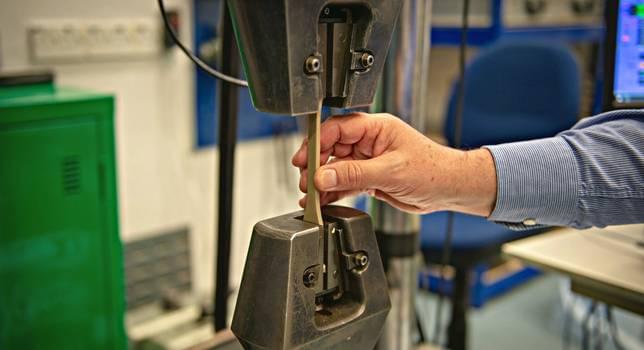
Because these materials are so specialized, a datasheet is rarely enough to guarantee performance. This is where independent testing becomes a strategic advantage for both manufacturers and end-users.
For Manufacturers: Testing is the proof of innovation. It validates that a new eco-friendly compound or a lighter reinforcement truly meets the rigorous performance and durability standards required by the market.
For End-Users: Testing can be an insurance policy. By performing benchmarking studies—such as comparing the abrasion resistance or adhesion strength of two different brands, procurement teams can move away from "price-per-foot" buying. Instead, they can invest in the total cost of ownership, better understanding how many years of service they can expect before a replacement may be needed.
Data Over Guesswork
As we move toward more automated, energy-conscious, and high-velocity operations, the difference between success and failure often comes down to the properties of the rubber, polymers, and reinforcements moving a wide variety of materials, products, and packages.
By prioritizing material science and rigorous testing, companies can ensure their systems aren't just moving—they are performing with maximum efficiency. After all, the cost of a high-quality belt is a fraction of the cost of a failed one.
.jpg?ext=.jpg)